By Bilal Siali · Last updated September 3, 2026
Short answer: a full-size household refrigerator commonly uses about 1,000-1,600 watt-hours (Wh) per day, based on typical figures published by ENERGY STAR and the U.S. Department of Energy — that daily figure, not the running-watts number on the door sticker, is what determines the power station capacity you need.
A refrigerator is one of the most common reasons people buy a portable power station, and it is also one of the easiest appliances to undersize for if you only look at that door-sticker number.
This guide walks through the same watts-vs-watt-hours method used throughout PowerMatchLab, applied specifically to a fridge or freezer, so you can size a station with confidence instead of guessing. If you're not yet sure a power station can handle a fridge's startup surge at all, see PowerMatchLab's dedicated feasibility guide first.
Ready to put a number on this for your own setup?
Calculate your Refrigerator & Freezer power needs →Key takeaways
- A full-size fridge commonly uses about 1,000–1,600 Wh/day — check with a plug-in energy meter for your real figure.
- The station's surge rating, not just its continuous rating, must clear the compressor's startup spike (often 2–3× running watts).
- Recommended capacity ≈ (daily energy × days) ÷ 0.85 usable-energy × 1.2 reserve.
- Multi-day outages multiply energy needs fast — solar input or an expandable platform usually beats one oversized fixed battery.
- Pure sine wave AC (standard on PowerMatchLab-listed stations) runs a compressor more smoothly than modified-sine-wave power.
Watts tell you if it will start; watt-hours tell you how long it will run
Watts (W) measure how much power your fridge pulls at a given instant. Watt-hours (Wh) measure energy used over time — watts multiplied by hours. A power station has two separate specs that map to these: a continuous output rating in watts, and a battery capacity in watt-hours.
Sizing for a fridge means clearing both bars: the station's output must handle the compressor's peak demand, and its capacity must hold enough energy for however long you need the fridge running before you can recharge.
Step 1: Find your fridge's real power draw
Do not rely on a guess. Check the rating label — usually inside the fridge on a side wall, or on the back or bottom — for its running watts, or its amps and voltage (watts ≈ amps × volts). The owner's manual usually repeats the same figures.
The label shows a rated maximum, not what the compressor actually pulls while cycling on and off. For a real number, plug the fridge into an inexpensive plug-in energy meter for 24 hours; it will report actual watt-hours used that day, which is the number that matters for sizing.
Step 2: Account for the startup surge
A compressor briefly pulls far more than its running watts the instant it starts — commonly two to three times as much, for well under a second. A fridge that runs at 150 W might surge to 300-450 W or more on startup.
Check your power station's surge or peak output rating, not only its continuous rating. If the surge rating does not comfortably clear your fridge's startup spike, the station can shut off or fail to start the compressor at all — even though its continuous wattage looked like plenty on paper.
Step 3: Estimate daily energy use
Because the compressor cycles rather than running continuously, a full-size household refrigerator commonly uses somewhere in the range of 1,000-1,600 Wh per day, based on typical figures published by ENERGY STAR and the U.S. Department of Energy. A warmer room, an older or less efficient unit, a full-size side-by-side, frequent door openings, or a warm kitchen can push that higher; an efficient, well-sealed unit in a cool space can run lower.
Treat that range as a starting point only — the 24-hour energy-meter reading from Step 1 is a far more accurate number for your specific fridge, in your specific kitchen, at your specific ambient temperature.
Step 4: Convert daily energy into a recommended capacity
A power station never delivers 100% of its rated capacity to your fridge — inverter and conversion losses take a share. PowerMatchLab plans around 85% usable energy, the same conservative planning figure used in the Power Calculator.
It's also worth keeping roughly 20% reserve headroom above the bare minimum, so the battery isn't run flat every cycle and there's margin for estimate error. Put together: recommended minimum capacity (Wh) ≈ (daily energy Wh × days of autonomy) ÷ 0.85 × 1.2.
Worked example: your energy meter shows the fridge uses 1,200 Wh in 24 hours, and you want to cover one full day without recharging. 1,200 ÷ 0.85 × 1.2 ≈ 1,694 Wh. A station rated meaningfully above that — leaving room to also run a few lights or charge a phone — gives comfortable margin.
For multi-day outages, multiply the daily figure by the number of days first. Two days at 1,200 Wh/day is 2,400 Wh of demand before the efficiency and reserve adjustments — capacity requirements grow quickly, which is where solar input becomes valuable.
Sizing for a specific blackout length: 8, 12, or 24 hours
If you're planning around a specific outage length rather than a full day, prorate the same 1,200 Wh/day reference figure by the fraction of a day you need to cover, then apply the same 85% usable-energy and 20% reserve adjustments as Step 4. This assumes the fridge's energy use is spread roughly evenly across the day — a reasonable planning simplification, not a precise model of its actual cycling.
The Power Calculator already starts with a refrigerator pre-added as an example device (150 W running, 8 hours/day) — edit its running watts and hours to match your own model's real numbers, then set your target hours or days of autonomy for a figure tied to your exact fridge rather than this reference range.
- 8 hours: 1,200 × (8 ÷ 24) = 400 Wh ÷ 0.85 × 1.2 ≈ 565 Wh minimum recommended capacity
- 12 hours: 1,200 × (12 ÷ 24) = 600 Wh ÷ 0.85 × 1.2 ≈ 847 Wh minimum recommended capacity
- 24 hours: 1,200 Wh ÷ 0.85 × 1.2 ≈ 1,694 Wh minimum recommended capacity — the same figure as the worked example above
Step 5: Confirm continuous output covers everything running at once
Add the running watts of the fridge to anything else you plan to run at the same time — a few lights, a router, a phone charger. That total is your required continuous output, separate from the capacity question above.
All PowerMatchLab-listed stations output pure sine wave AC, the type generally recommended for compressor motors; it runs the compressor more smoothly and quietly than a modified-sine-wave inverter.
Mini fridges, chest freezers, and other variants
A dorm-size mini fridge or a beverage cooler typically draws less power and less daily energy than a full-size kitchen refrigerator, so a smaller, lighter station can cover it — but confirm with the same label check and, ideally, a real energy-meter reading rather than assuming it's automatically small.
A standalone chest freezer can use more or less energy than a fridge depending on size, insulation, and how full it is (a fuller freezer holds cold better and cycles less); size it the same way, using its own measured or labeled figures rather than the fridge's.
Extending runtime for longer outages
Solar input lets a station recharge during the day while still running the fridge, which can extend — or in good sun, sustain indefinitely — fridge-only operation. Real-world solar output is usually well below a panel's rated watts; PowerMatchLab's solar guide covers why.
An expandable platform lets you add battery modules later instead of buying a second, separate unit if your outage-duration needs grow.
Put a number on it
Related products
These picks are focused on the U.S. market. Before buying, confirm plug type, voltage (120V), warranty terms, and regional availability on the Amazon listing — especially if you are ordering to another country.
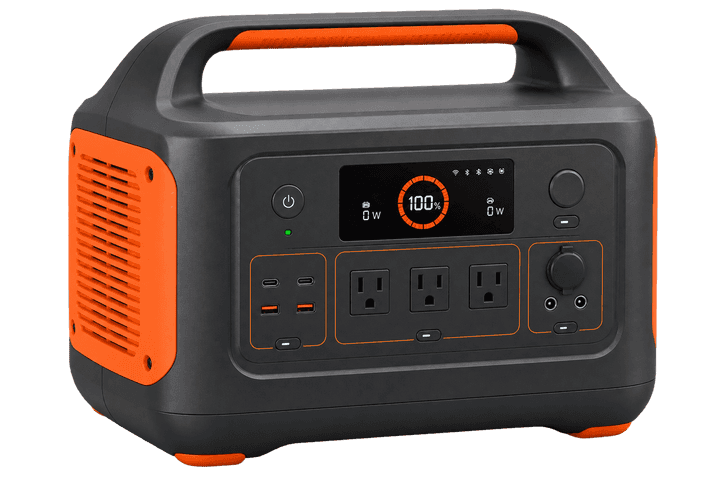
Illustrative image — not an exact product photograph.
- Capacity
- 2,042 Wh
- Output
- 2,200 W
- Weight
- 39.5 lb (17.9 kg)
Best for: home backup, refrigerator and freezer backup, RV use, camping
Price, availability and current rating are shown on Amazon — PowerMatchLab does not display them because we have not independently verified them. As an Amazon Associate we may earn from qualifying purchases.
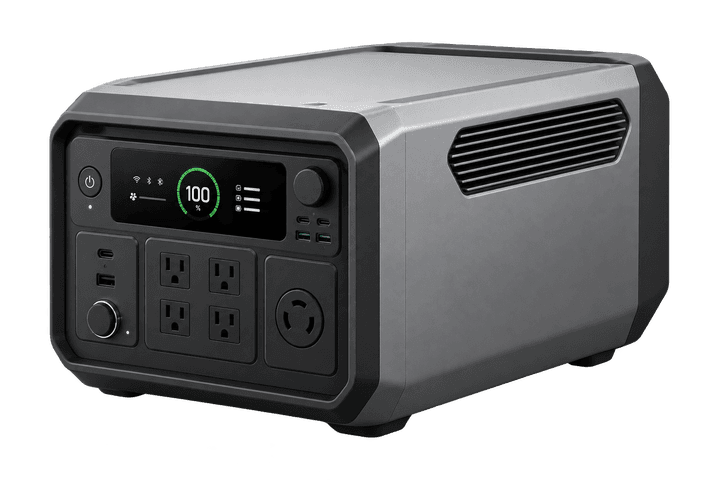
Illustrative image — not an exact product photograph.
- Capacity
- 1,024 Wh
- Output
- 1,800 W
- Weight
- 26.7 lb (12.1 kg)
Best for: home essentials, refrigerator backup, camping, electronics
Price, availability and current rating are shown on Amazon — PowerMatchLab does not display them because we have not independently verified them. As an Amazon Associate we may earn from qualifying purchases.
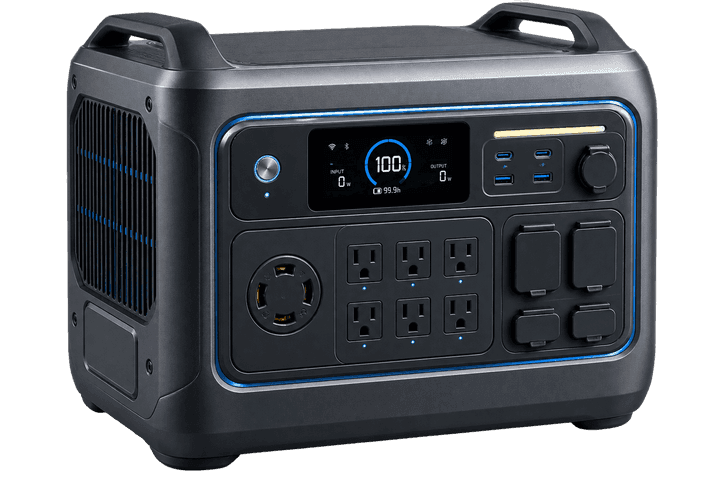
Illustrative image — not an exact product photograph.
- Capacity
- 2,048 Wh
- Output
- 2,400 W
- Weight
- 41.7 lb (18.9 kg)
Best for: RV, refrigerator backup, home essentials, camping
Price, availability and current rating are shown on Amazon — PowerMatchLab does not display them because we have not independently verified them. As an Amazon Associate we may earn from qualifying purchases.
Related guides
FAQ
Will a small, ~300Wh power station run a refrigerator?
Only briefly. A compact station in the 288-300Wh class may be able to start a small fridge, but typically sustains it for only a couple of hours at most, and on some very compact units the surge draw alone can be a problem. For anything beyond a short bridge, a 1kWh-class or larger station is the realistic starting point.
Does a power station need a special mode to run a fridge?
No special mode is generally required — the station just needs to comfortably clear the fridge's surge and continuous watts, and hold enough capacity for your target runtime. Some stations offer a UPS/pass-through mode, useful if you want the fridge on wall power normally and only on battery during an actual outage.
How accurate is the 1,000-1,600 Wh/day range?
It's a reasonable planning range for a typical full-size refrigerator, not a guarantee for your unit. Age, size, ambient temperature and usage habits all move the real number meaningfully — a 24-hour plug-in energy meter reading is the most reliable way to replace the range with your own figure.
Sources
- ENERGY STAR — Refrigerators
- U.S. Department of Energy — "Your Refrigerator Is Only As Efficient As You"
- Manufacturer-published specifications, attributed by brand in products.json
Last updated September 3, 2026. This guide is educational and general; it does not assert product-specific performance beyond what products.json verifies. As an Amazon Associate, PowerMatchLab earns from qualifying purchases made through the Amazon links on this page — see the disclosure.