By Bilal Siali · Last updated September 1, 2026
Short answer: yes, most 1kWh-class and larger power stations can run a household refrigerator, commonly for somewhere around 12-24+ hours per full charge depending on capacity and the fridge's real draw — with two caveats: the station's surge rating must clear the compressor's startup spike, and the exact runtime depends on your specific fridge.
This guide covers both the feasibility check and the runtime math, so you can answer "will it work" and "for how long" together. If you already know a fridge is a safe bet for your setup and just need to work out exactly what capacity to buy, PowerMatchLab's dedicated sizing guide walks through that calculation step by step.
Ready to put a number on this for your own setup?
Calculate your Refrigerator & Freezer power needs →Key takeaways
- The startup surge (often 2–3× running watts) is the first hurdle — check it against the station's surge/peak rating.
- A household fridge typically uses about 1,000–1,600 Wh/day because the compressor cycles rather than running continuously.
- Estimated runtime (hours) = usable capacity (≈85% of rated Wh) ÷ the fridge's average running watts.
- A 1,000Wh-class station commonly runs a ~150 W fridge for roughly 5-6 hours of continuous compressor operation, but cycling stretches wall-clock coverage further — see the worked table below.
- Solar input can extend or, in good conditions, indefinitely sustain fridge-only operation.
The startup surge is the first hurdle
A fridge compressor can briefly pull two to three times its running watts when it kicks on. If a device draws 150 W running, its surge might be 400-800 W for a moment.
Any power station whose surge (peak) rating comfortably exceeds that spike should start it without tripping.
Daily energy, not running watts
Because the compressor cycles, a household fridge typically uses roughly 1,000-1,600 Wh per day. A warm room, a full fridge, or frequent door openings push it higher.
Divide the station's usable energy (about 85% of nameplate) by that daily figure to estimate days of fridge-only runtime.
Estimating runtime
PowerMatchLab's product pages show an estimated runtime table using estimated_runtime_hours = capacity_wh × 0.85 ÷ device_watts. Treat it as a planning estimate, not a guarantee — your fridge's real draw varies.
Applied to a ~150 W fridge (a common published average) across a few capacity classes now in the PowerMatchLab catalog, from compact to whole-home-backup units:
- ~300Wh-class (e.g. a compact unit): 300 × 0.85 ÷ 150 ≈ 1.7 hours
- ~1,000Wh-class: 1,000 × 0.85 ÷ 150 ≈ 5.7 hours
- ~2,000Wh-class: 2,000 × 0.85 ÷ 150 ≈ 11.3 hours
- ~4,100Wh-class (the largest currently listed): 4,100 × 0.85 ÷ 150 ≈ 23.2 hours
Keeping the fridge going for longer
Pairing the station with solar input can extend or indefinitely sustain fridge-only operation in good conditions.
Expandable platforms let you bolt on extra battery capacity for multi-day outages.
For a number tied to your exact fridge rather than the ~150 W reference used above, use the Power Calculator — it already starts with a refrigerator pre-added as an example device, so you can edit its running watts and hours to match your own model directly.
Put a number on it
Related products
These picks are focused on the U.S. market. Before buying, confirm plug type, voltage (120V), warranty terms, and regional availability on the Amazon listing — especially if you are ordering to another country.
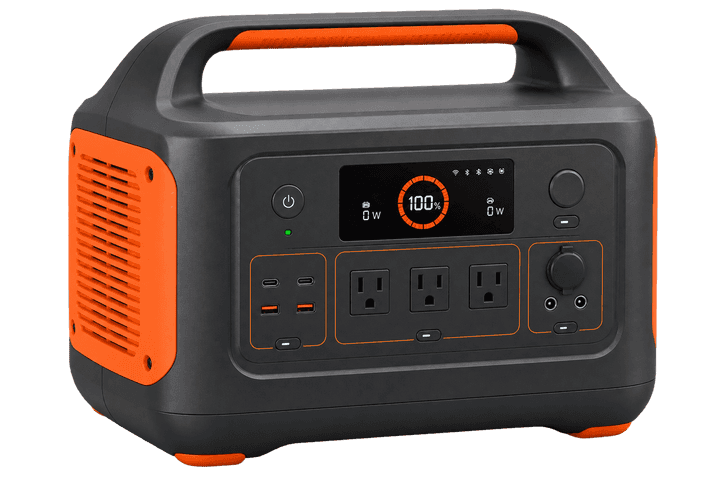
Illustrative image — not an exact product photograph.
- Capacity
- 2,042 Wh
- Output
- 2,200 W
- Weight
- 39.5 lb (17.9 kg)
Best for: home backup, refrigerator and freezer backup, RV use, camping
Price, availability and current rating are shown on Amazon — PowerMatchLab does not display them because we have not independently verified them. As an Amazon Associate we may earn from qualifying purchases.
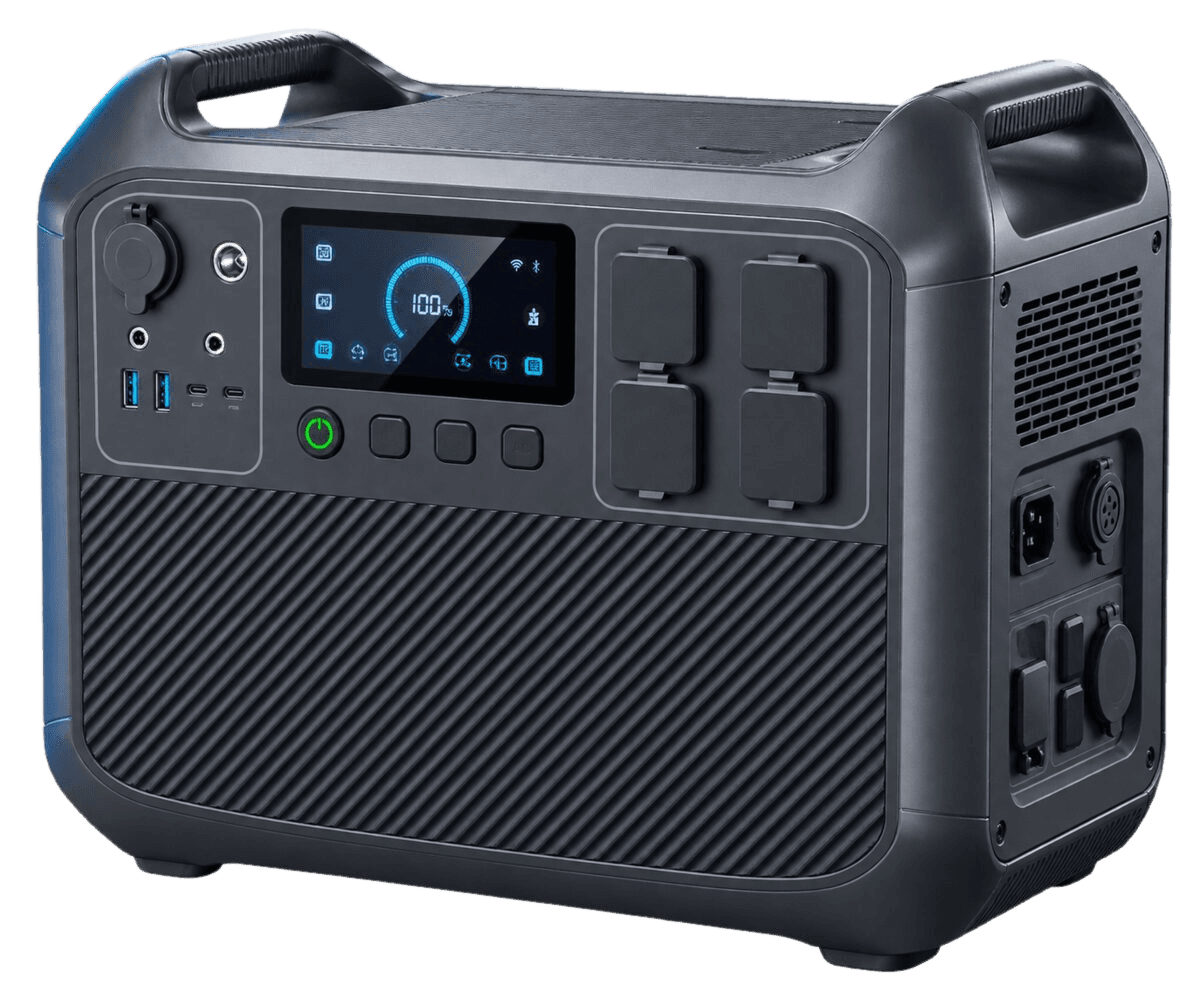
Illustrative image — not an exact product photograph.
- Capacity
- 2,048 Wh
- Output
- 2,400 W
- Weight
- 62.4 lb (28.3 kg)
Best for: home backup, RV use, off-grid use
Price, availability and current rating are shown on Amazon — PowerMatchLab does not display them because we have not independently verified them. As an Amazon Associate we may earn from qualifying purchases.
Related guides
FAQ
Will a 300Wh power station run a fridge?
Only very briefly. A compact 288-300Wh unit may start a small fridge but will typically last only a couple of hours, and some small units cannot handle the surge at all.
How do I measure my fridge's real energy use?
Plug it into an inexpensive plug-in energy meter for 24 hours. That gives you a real Wh/day figure to use in the calculator.
Sources
- ENERGY STAR — Refrigerator energy use references
- Manufacturer-published specifications, attributed by brand in products.json
Last updated September 1, 2026. This guide is educational and general; it does not assert product-specific performance beyond what products.json verifies. As an Amazon Associate, PowerMatchLab earns from qualifying purchases made through the Amazon links on this page — see the disclosure.