By Bilal Siali · Last updated September 1, 2026
Charging specs are easy to misread. This guide covers what AC charging watts, solar input watts, and quoted charging times actually tell you — with a worked example for each. For solar-specific worked examples across a few panel sizes, see PowerMatchLab's dedicated solar charging-time guide, linked below.
Key takeaways
- AC charging watts and solar input watts are two separate specs — a station's fastest possible recharge uses AC, not solar.
- Charging time (hours) ≈ capacity (Wh) ÷ charging input (W) — but the last 10-20% tapers, so real full-charge time runs a bit longer than the raw division.
- Real-world solar routinely delivers only 60-80% of a panel's rated watts because of angle, temperature, haze, and wiring losses.
- Some stations accept simultaneous AC + solar input for faster combined charging — check the spec sheet, since not all support it.
- PowerMatchLab shows charging specs exactly as published by the manufacturer; an unknown value is shown as "Not verified," never guessed.
AC (wall) charging
AC charging watts is the fastest a station refills from a normal outlet. Charging time (hours) ≈ capacity (Wh) ÷ AC charging watts, though the last 10-20% of any charge tapers to protect the battery, so quoted 'full charge' times run a little longer than the raw division suggests.
Worked example using real catalog specs: the EcoFlow DELTA 3 Classic (1,024 Wh) has a documented 1,400 W AC charging input. 1,024 ÷ 1,400 ≈ 0.73 hours (about 44 minutes) for the raw calculation — consistent with EcoFlow's own published "~1 hour" full-charge figure once tapering is factored in.
Fast AC charging is convenient but repeatedly charging at maximum rate can add heat; some units let you choose a slower, cooler charging mode.
Solar input
Solar input watts is the maximum the charge controller will accept, along with a voltage and current window your panels must stay within.
Real-world solar routinely delivers 60-80% of a panel's rating because of angle, temperature, haze, wiring losses and time of day. Size your array so its rating comfortably exceeds your daily energy need.
Planning a realistic recharge
For off-grid use, the useful question is whether a day's solar harvest replaces a day's energy use. If your panels realistically make 1,500 Wh on an average day and you use 1,200 Wh, you have margin.
The PowerMatchLab charging figures come straight from manufacturer specs; where a value is unknown we show 'Not verified' rather than guessing.
Put a number on it
Related products
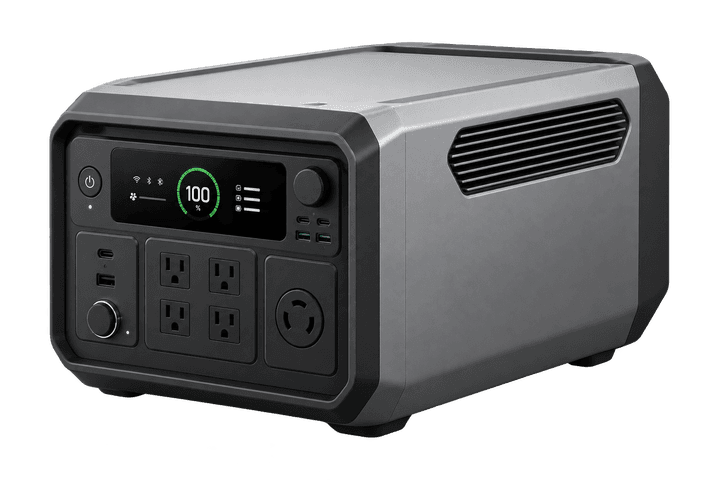
Illustrative image — not an exact product photograph.
- Capacity
- 1,024 Wh
- Output
- 1,800 W
- Weight
- 26.7 lb (12.1 kg)
Best for: home essentials, refrigerator backup, camping, electronics
Price, availability and current rating are shown on Amazon — PowerMatchLab does not display them because we have not independently verified them. As an Amazon Associate we may earn from qualifying purchases.
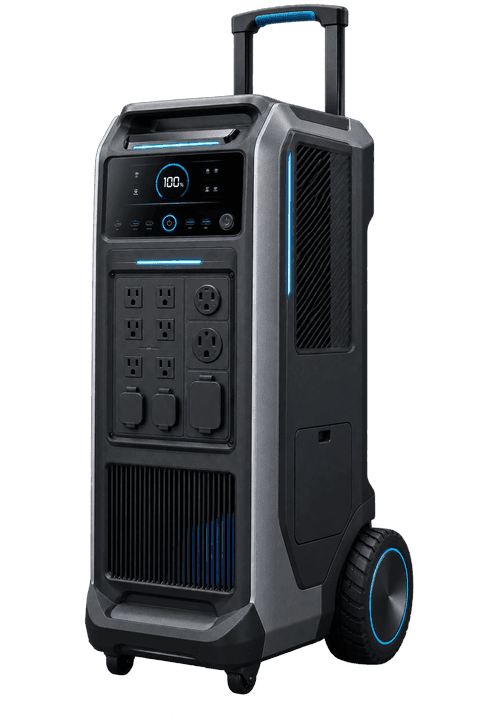
Illustrative image — not an exact product photograph.
- Capacity
- 3,840 Wh
- Output
- 6,000 W
- Weight
- 132.3 lb (60 kg)
Best for: whole-home backup, RV, 240V appliances, EV emergency charging
Price, availability and current rating are shown on Amazon — PowerMatchLab does not display them because we have not independently verified them. As an Amazon Associate we may earn from qualifying purchases.
Related guides
FAQ
Can I charge from solar and AC at the same time?
Many stations support simultaneous AC + solar input for faster charging, but not all. Check the spec sheet for combined input limits.
Why is my solar input lower than the panel rating?
Panels are rated under ideal lab conditions. Real output depends on sun angle, temperature, shading and cabling. 60-80% of the rating on a good day is typical.
Sources
- U.S. Department of Energy / NREL — Understanding Solar Photovoltaic System Performance
- Manufacturer charging specifications referenced in products.json
Last updated September 1, 2026. This guide is educational and general; it does not assert product-specific performance beyond what products.json verifies. As an Amazon Associate, PowerMatchLab earns from qualifying purchases made through the Amazon links on this page — see the disclosure.